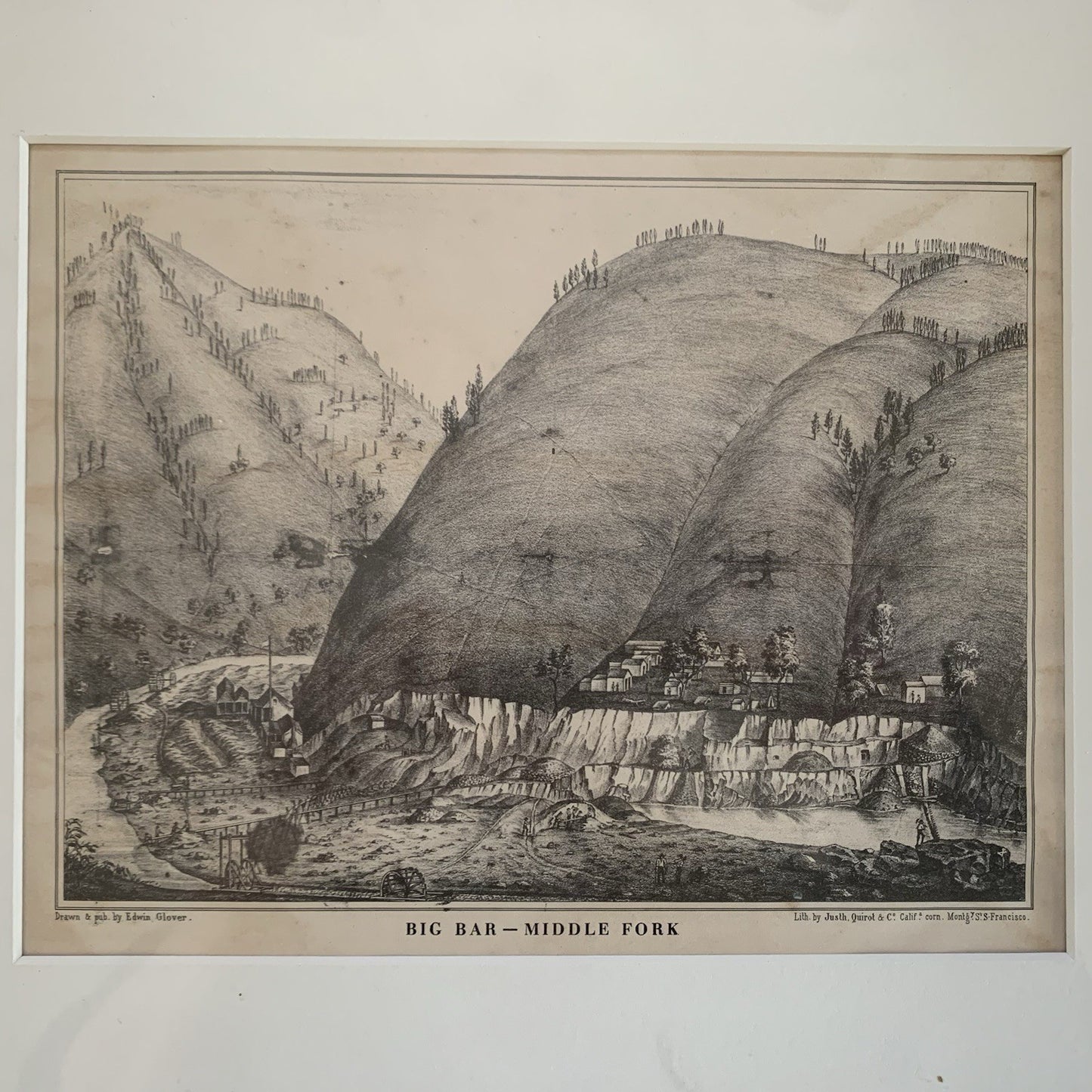
Big Bar - Middle Fork.
Lithograph by Justh Quirot & Co. California corner Montgomery Street San Francisco. Drawn and published by Edwin Glover.
Print 7.5” x 9.5”. Some sunning and mild staining. Frame 11.25” x 14.25”. Circa 1851.
I believe the stamp on the reverse says: San Francisco Historical Society. Organized December 15, 1926.
University of California Library description is “Hydraulic mining operation in steep ravine along river; numerous buildings of mining camp, water wheels, and sluices. Miners working with picks along excavated hillside.”
Justh, Quirot & Co. was one of the earliest and most important lithographic printing houses in San Francisco, operating from approximately 1851 to 1853. The firm primarily produced pictorial letter sheets—illustrated stationery that people could use for correspondence. These often depicted dramatic events in San Francisco during the Gold Rush era, including fires, vigilante executions, and city views.
Big Bar, located along the Middle Fork of the American River in Placer County, California, emerged as one of the significant mining camps during the frenzied early years of the Gold Rush. Following James Marshall's discovery at Sutter's Mill in January 1848, prospectors rapidly spread throughout the American River drainage system, and the Middle Fork became one of the richest gold-bearing tributaries. Big Bar gained its name from the extensive gravel bar deposits that proved exceptionally productive for placer mining operations. By 1849-1850, the site had developed into a bustling mining community where hundreds of argonauts worked the river bars and benches, employing techniques ranging from simple panning to more elaborate sluicing and hydraulic operations. The remote canyon location, while challenging to access, offered the promise of rich strikes that drew fortune-seekers from around the world. Like many Middle Fork camps, Big Bar's population fluctuated dramatically with mining successes and failures, but it remained an active mining district well into the 1850s and represented the archetypal California mining camp—isolated, rough-hewn, and animated by the eternal optimism that the next pan of gravel might yield a fortune.
Satisfaction guaranteed or you can send it back!